
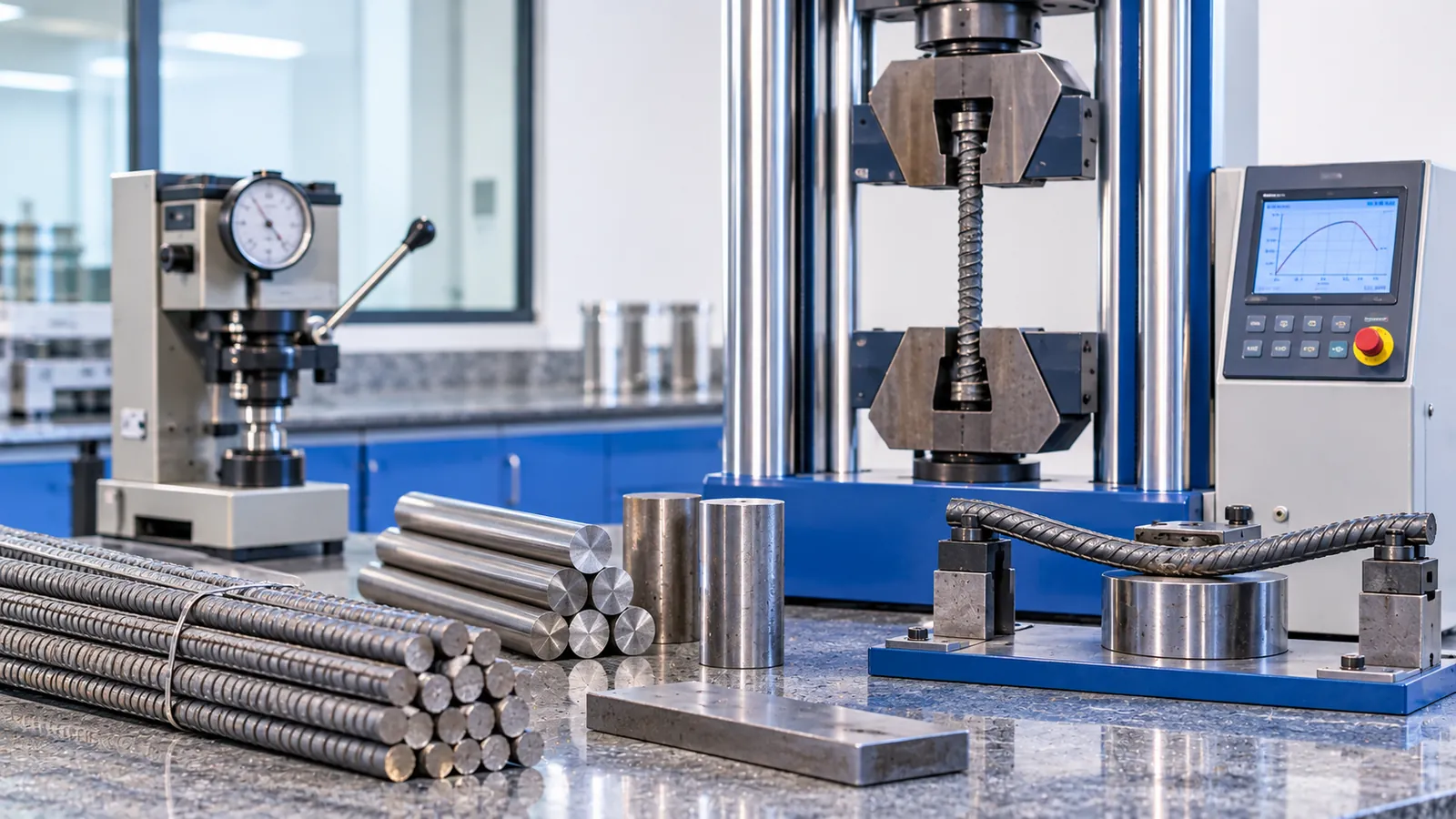
A bundle of TMT bars arrives at your construction site. They look clean, the ribs are visible, and the supplier has provided the paperwork. But does that mean the steel is actually compliant with the required specification? Not necessarily.
TMT steel quality cannot be verified by appearance alone. You need to look at its dimensions, rib geometry, mechanical properties, chemical composition, and traceability.
And there is an important site reality that often gets overlooked. Teams sometimes reject reinforcement because of light surface oxidation, while paying much less attention to smooth or poorly formed ribs. That is the wrong priority. Light surface oxidation does not automatically make reinforcement unacceptable. However, inadequate rib geometry can affect the mechanical bond between the steel and concrete.
So the question is not simply, "Does the steel look new?" It is:
"Does the steel meet the required specification, and can we prove it?"
THE REAL-WORLD RISK OF SUBSTANDARD TMT STEEL
Reinforcement is a critical part of a reinforced concrete structure. If the steel does not meet the specified requirements, the consequences can include:
- Lower yield or tensile strength
- Inadequate ductility
- Incorrect dimensions or mass
- Poor bond characteristics
- Problems during bending or fabrication
- Welding-related problems
- Difficulty establishing material traceability
The timing also matters. If questionable steel is identified before installation, replacement is relatively straightforward. If it has already been cut, bent, placed, and embedded in concrete, investigation and corrective action can become considerably more expensive.
The real cost is not just the price of the steel. It is the cost of discovering a problem too late.
IMMEDIATE ON-SITE VISUAL & PHYSICAL CHECKS
Before laboratory testing, start with basic site checks.
Check manufacturer identification
Look for the manufacturer's markings on the bars and match them with the supplied documentation. A marking helps with identification, but it does not prove compliance by itself.
Check diameter and ribs
Measure the bar diameter using an appropriate method rather than relying on visual estimation. Also inspect the rib pattern. Look for:
- Consistent rib formation
- Proper rib height and geometry
- Obvious rolling defects
- Significant surface damage
The ribs are not decorative. They contribute to the mechanical interaction between reinforcement and concrete.
Do not panic over light oxidation
Light surface oxidation is not automatically a reason to reject reinforcement. What matters is the extent and nature of the corrosion. Deep pitting, flaking, significant section loss, or deterioration that affects performance deserves much closer attention. So instead of asking "Is there rust?", ask:
"Has the steel deteriorated enough to affect its required performance?"
ESSENTIAL LABORATORY & MECHANICAL TESTS
Visual inspection cannot establish all the properties that matter. Depending on the applicable specification, reinforcement may need testing for:
- Yield strength
- Tensile strength
- Elongation
- Bend and rebend behaviour
- Mass and dimensional requirements
Strength alone is not enough. Ductility matters too, particularly because reinforcement needs to deform appropriately under structural loading.
Laboratory testing provides evidence that the steel supplied to the project actually meets the specified mechanical requirements.
CHEMICAL COMPOSITION ANALYSIS
Chemical composition becomes particularly important when reinforcement is going to be welded. Elements such as carbon, manganese, silicon, sulphur, and phosphorus influence the properties and weldability of steel. One important parameter is carbon equivalent, which is used to assess weldability.
The welding trap
Welding reinforcement on site may seem like a convenient shortcut for connecting bars. But before welding, the team should verify the steel grade, chemical composition, applicable requirements, and welding procedure. If the steel's carbon equivalent or other characteristics make it unsuitable for the proposed welding procedure, the heat-affected zone can develop undesirable properties.
Do not treat TMT welding as a routine site shortcut. Verify weldability first.
DOCUMENTATION, BATCH REPORTS & CHAIN OF CUSTODY
A laboratory report is only useful if you know exactly which steel was tested. Maintain a clear connection between:
Important records can include:
- Manufacturer details
- Steel grade
- Diameter
- Batch or heat number
- Mill test certificate
- Delivery challan
- Sampling records
- Laboratory reports
- Acceptance or rejection records
If a sample cannot be traced back to the material delivered to site, the test result becomes much less useful.
SIMPLE TMT STEEL VERIFICATION CHECKLIST
Before reinforcement goes into the structure:
THE BOTTOM LINE
Do not judge TMT steel only by how new or clean it looks. Light surface oxidation is not automatically the problem. Poor rib geometry, inadequate mechanical properties, unsuitable chemical composition, and weak traceability can be far more important.
The same applies to welding. A faster connection is not necessarily a safe connection if the steel's weldability has not been established. The safest approach is straightforward:
Check the steel before the concrete hides it.
Once reinforcement is inside the concrete, correcting a material-quality problem becomes far more complicated.