
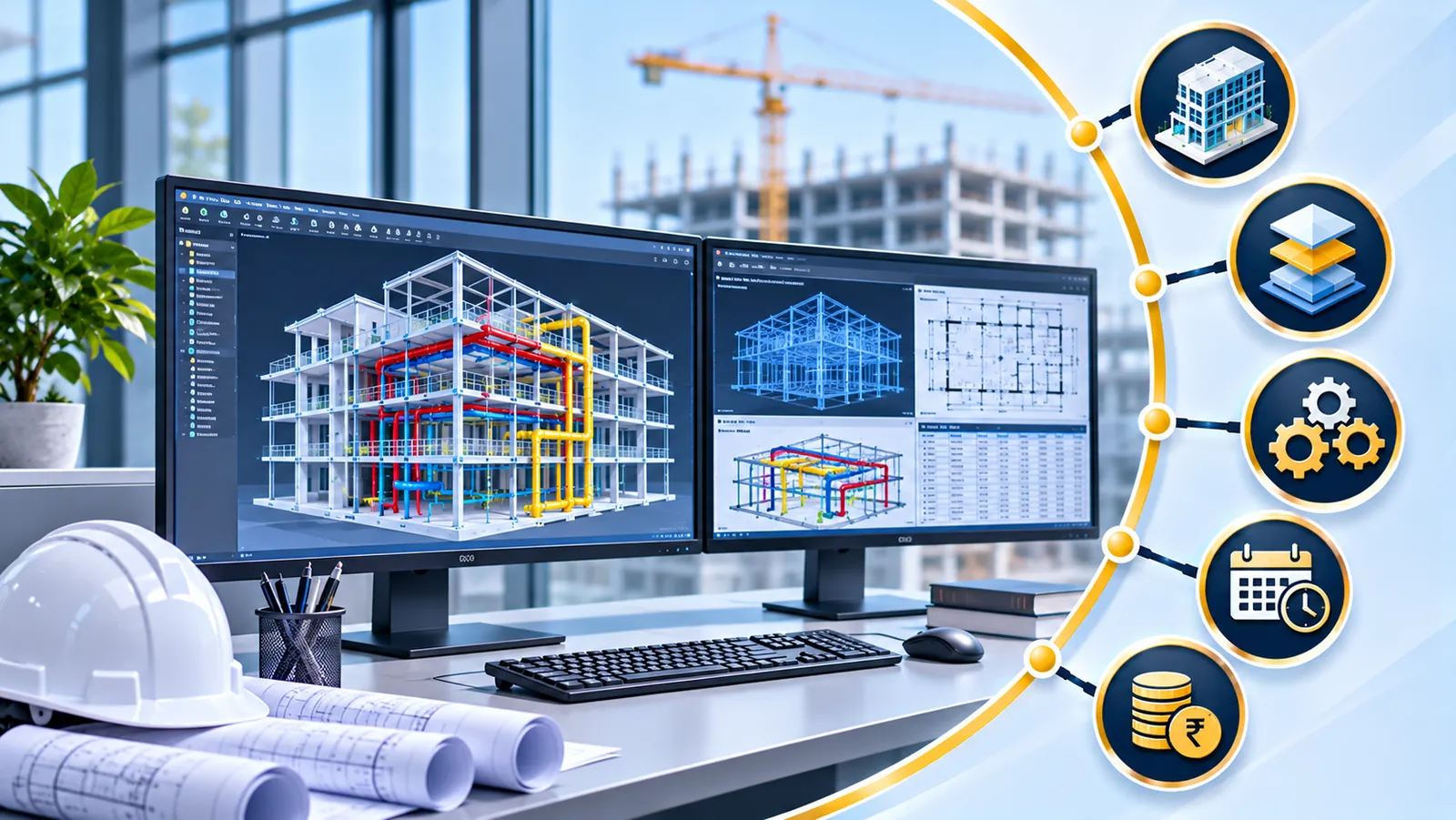
For decades, Indian construction ran on 2D drawings, manual coordination, and on-site clash resolution. The result: cost overruns, schedule slips, and rework that ate into project margins. Building Information Modelling (BIM) is changing this — not gradually, but rapidly. Government tenders now require BIM. Major developers mandate it. The question isn't whether to adopt BIM. It's how fast.
WHAT IS BIM (AND WHAT IT ISN'T)
BIM is often confused with 3D modelling. They're not the same.
3D model: Geometry. You can rotate it, view it, render it.
BIM: Geometry + Information. Every element has data — material, manufacturer, fire rating, cost, installation date, maintenance schedule, energy performance.
BIM is a centralised, data-rich digital model that serves as the single source of truth for everyone involved — architect, structural engineer, MEP designer, contractor, owner, facility manager. The model evolves through the project lifecycle.
WHY BIM ADOPTION IS ACCELERATING IN INDIA
Multiple forces are pushing Indian construction toward BIM:
THE ACTUAL BENEFITS OF BIM
INDUSTRY DATA
Studies show BIM-adopted projects in India typically show 7-15% cost savings, 10-25% schedule reduction, and 60-80% reduction in design-related RFIs during construction.
UNDERSTANDING LOD: LEVEL OF DEVELOPMENT
Not all BIM models are equal. LOD defines how detailed the model is:
The right LOD depends on project stage. Design competitions need LOD 100-200. Construction docs need LOD 300-350. Pre-fabrication needs LOD 400. Asking for LOD 400 at design stage is over-investing; delivering LOD 200 for construction is under-investing.
WHERE TO START WITH BIM
If your firm hasn't adopted BIM yet, here's a practical roadmap:
BIM is not optional in India anymore.
Five years from now, firms without BIM capability will be locked out of major government and private projects. The sooner you transition, the smoother — and the more profitable — your firm's next decade will be.