
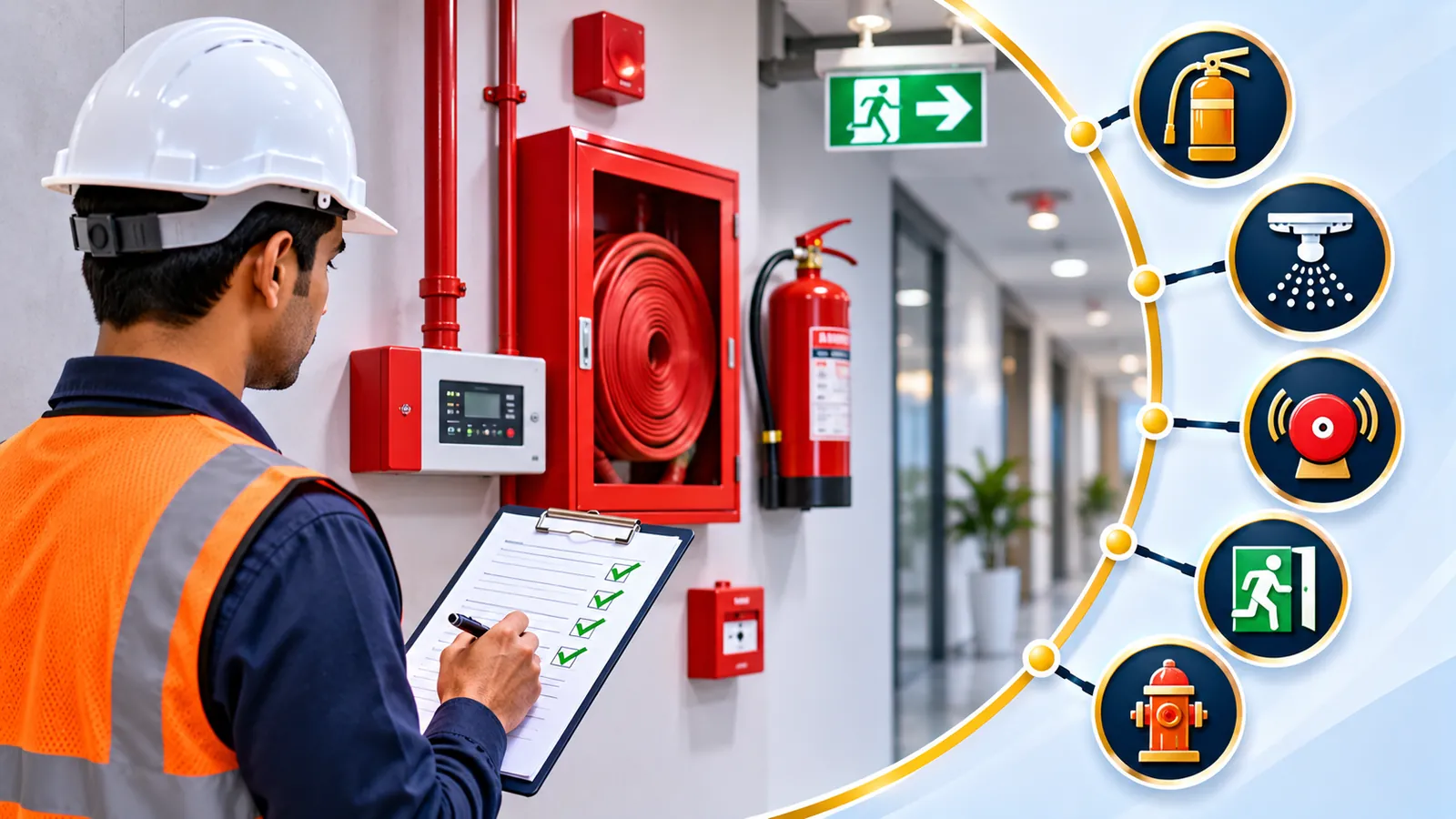
Fire Safety Audits: The Audit That Could Save Lives

Author: Namotech Team
01 MAR 2024
6 MIN READ
Fire Safety Audits: The Audit That Could Save Lives
NAMOTECH RESEARCH ARCHIVE

Every Indian newspaper has carried the headlines: hospital fire kills 8, coaching centre fire kills 22, shopping complex fire traps shoppers. Behind every tragic headline is the same root cause — fire safety audits that were either skipped, faked, or ignored. NBC 2016 is clear, the technology exists, the engineering is well-understood. What's missing is the discipline to audit, verify, and act.

WHY FIRE SAFETY AUDITS ARE NON-NEGOTIABLE

India sees thousands of fire incidents in commercial and institutional buildings annually. Most aren't unpredictable — they're failures of fire safety systems that auditors should have caught years before.

Common failure patterns:

KEY PROCEDURAL OBSERVATIONS & STANDARDS
Fire exits blocked by stored materials
Sprinkler systems untested for years
Emergency lighting non-functional
Fire alarms disconnected to stop 'false alarms'
Pumps and water tanks inadequate or empty
Staff untrained in evacuation procedures
Combustible false ceilings creating hidden fire spread paths

WHAT NBC 2016 REQUIRES

The National Building Code of India 2016 (Part 4 — Fire and Life Safety) mandates specific provisions based on building classification:

KEY PROCEDURAL OBSERVATIONS & STANDARDS
Compartmentation — Buildings divided into fire-resistant zones to prevent spread
Detection systems — Smoke/heat detectors, manual call points throughout
Alarm systems — Audible and visual alarms reaching every occupant
Suppression systems — Sprinklers, hydrants, fire extinguishers per zone classification
Means of egress — Minimum exit widths, travel distances, refuge areas
Emergency lighting — Battery-backed lighting on all exit paths
Pump and tank capacity — Adequate water storage and pressure for fire fighting
Fire-rated doors — Specific fire ratings (30-min, 60-min, 120-min) for openings

REGULATORY REALITY

Beyond NBC, state Fire Service Acts mandate periodic fire NOCs. Without a valid Fire NOC, a building can be sealed by authorities — but more importantly, occupants are at risk.

WHAT A PROPER FIRE SAFETY AUDIT COVERS

A thorough fire safety audit is not a checkbox exercise. It evaluates:

KEY PROCEDURAL OBSERVATIONS & STANDARDS
Passive fire protection — Compartmentation, fire-rated walls, smoke seals
Active fire protection — Sprinklers, hydrants, detection, alarms (functional testing)
Means of egress — Exit signs, evacuation routes, stairwell pressurisation
Fire pumps and water supply — Capacity verification, pressure testing
Electrical safety — Wiring loads, earth leakage, panel safety
Materials and finishes — Combustibility of false ceilings, partition materials
Staff preparedness — Training records, drill frequency, fire warden roles
Documentation review — Approved plans vs as-built, fire NOC validity
Risk-based recommendations — Critical / High / Medium priority interventions

FIRE AUDIT PRIORITIES BY BUILDING TYPE

KEY PROCEDURAL OBSERVATIONS & STANDARDS
Hospitals — Highest priority. Patients can't self-evacuate. Backup power critical.
Schools and coaching centres — Children + multiple exits + drill frequency
Shopping malls — Large open spaces + high occupant load + escalator stack effect
Hotels — Sleeping occupants + alarm wake-up + corridor smoke control
Industrial buildings — Hazard materials + sprinkler density + emergency response
High-rise residential — Refuge floors + pressurised stairwells + lift recall
Data centres — Clean agent systems (FM-200, Inergen) + zone-specific suppression

HOW OFTEN SHOULD YOU AUDIT?

KEY PROCEDURAL OBSERVATIONS & STANDARDS
Hospitals, schools: Annual third-party audit + quarterly internal check
Commercial high-rise: Every 2 years + system testing quarterly
Industrial: Annual + after any process change
After major renovation: Immediately, before re-occupation
Post-incident: Mandatory after any fire event

Fire safety isn't a one-time check.

Fire safety degrades silently. Sprinkler heads get blocked, batteries die in alarms, exit routes get obstructed, doors get propped open. Only periodic third-party fire safety audits catch these problems before disaster strikes.

NEED A FIRE SAFETY AUDIT?

Our team conducts NBC-compliant fire safety audits for hospitals, schools, malls, offices and industrial facilities.