
Pile Foundations: When Soil Won't Cooperate

Author: Namotech Team
10 MAR 2024
7 MIN READ
Pile Foundations: When Soil Won't Cooperate
NAMOTECH RESEARCH ARCHIVE

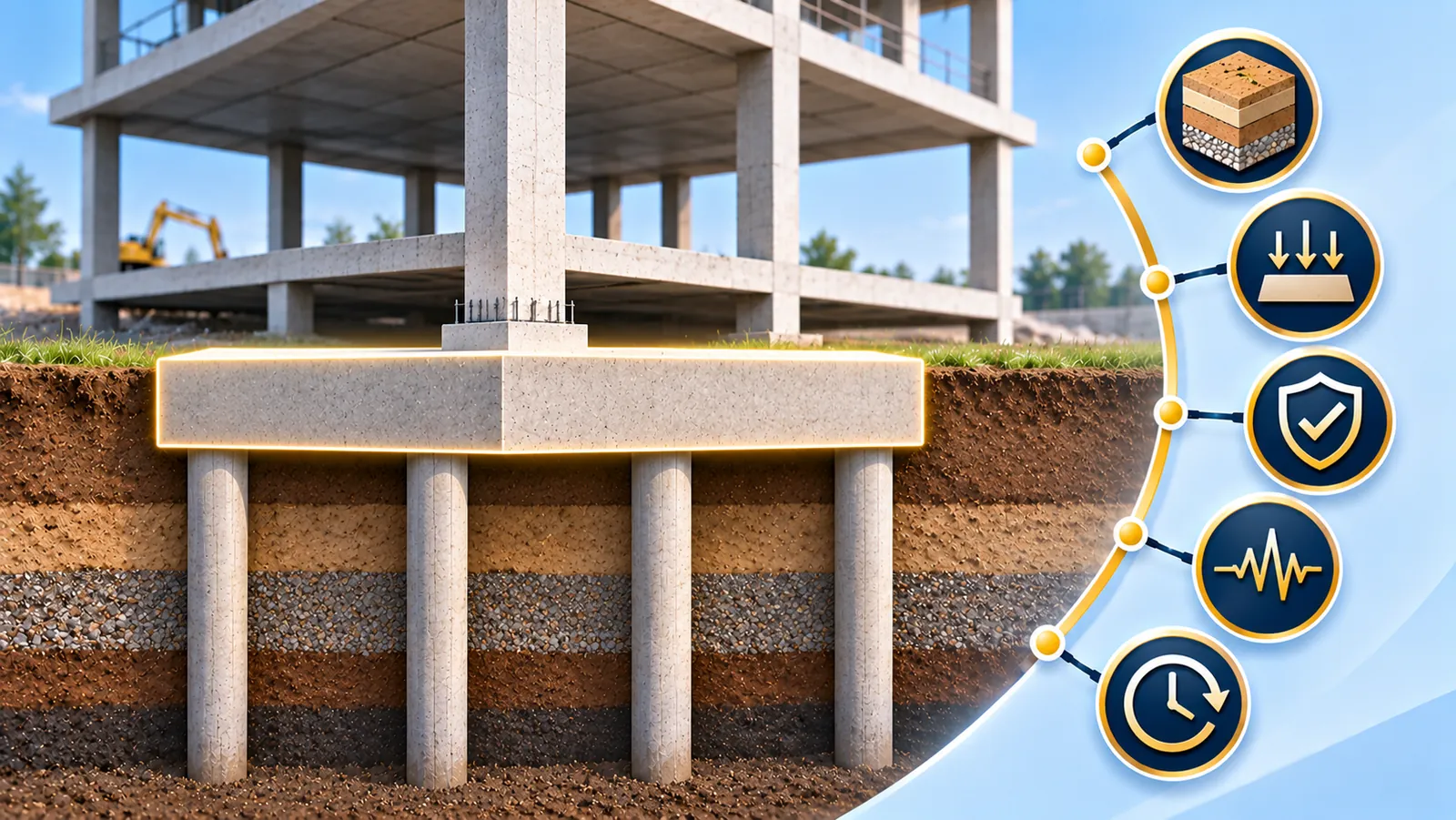
Sometimes the ground refuses to cooperate. Soft clay extending 20 meters down, high water table, sandy soil with poor bearing — these are the realities that force foundations deeper. Pile foundations transfer building loads through weak strata to stronger soil or rock below. They're more expensive than shallow foundations, but when needed, they're non-negotiable.

WHEN ARE PILE FOUNDATIONS NECESSARY?

Pile foundations are required when shallow foundations can't safely carry building loads. Specific scenarios:

KEY PROCEDURAL OBSERVATIONS & STANDARDS
Weak soil at shallow depths — Soft clay, loose sand, fill material
High groundwater table — Shallow foundations would face uplift issues
Heavy column loads — High-rise buildings, industrial structures, bridges
Expansive (black cotton) soils — Piles bypass the swelling-shrinking zone
Adjacent excavations — Underpinning existing buildings
Scour-prone areas — River bridges where soil can wash away
Seismic zones — Better lateral resistance and reduced liquefaction risk

MAJOR PILE TYPES USED IN INDIA

KEY PROCEDURAL OBSERVATIONS & STANDARDS
Bored Cast-in-Situ Piles — Most common in India. Diameters 300mm-2000mm. Depth up to 60m.
Driven Precast Piles — Pre-cast concrete piles hammered into ground. Fast but cause noise/vibration.
Driven Steel Piles — H-piles or pipe piles for heavy loads. Used in ports, bridges.
Auger Cast Piles (CFA) — Continuous Flight Auger. Fast, no vibration, but limited depth.
Under-Reamed Piles (IS 2911 Part 3) — Belled piles for expansive soils (uniquely Indian design).
Micropiles — Small diameter (100-300mm) for restricted access, underpinning.

FIELD CHOICE

For most building projects in Indian cities, bored cast-in-situ piles dominate because they're flexible (any depth), quiet (no driving noise), and can be installed under existing structures without vibration damage.

HOW PILE CAPACITY IS CALCULATED

A pile carries load through two mechanisms:

KEY PROCEDURAL OBSERVATIONS & STANDARDS
End bearing (point resistance) — Load transferred at the pile tip to deep firm soil/rock
Skin friction (shaft resistance) — Load transferred along the pile length via friction

Total ultimate capacity = End bearing + Skin friction. Safe load = Ultimate capacity ÷ Factor of Safety (typically 2.5 for design).

Calculation methods:

PILE LOAD TESTING: PROOF, NOT FAITH

Design calculations are predictions. Pile load tests are reality. Per IS 2911 Part 4:

KEY PROCEDURAL OBSERVATIONS & STANDARDS
Initial load test — One pile tested to 2-2.5× design load to verify design
Routine load test — Test piles at 1.5× design load (2% of total piles minimum)
Lateral load test — For piles subjected to lateral loads (bridge piers)
Pullout test — For piles in tension (transmission towers, uplift conditions)

Acceptance criteria: Settlement at 1.5× design load should not exceed specified limits (typically 12mm for buildings, custom for bridges). Residual settlement after unloading must be within tolerable limits.

PILE FOUNDATION DESIGN MISTAKES TO AVOID

KEY PROCEDURAL OBSERVATIONS & STANDARDS
Inadequate soil investigation — Pile design needs more boreholes than shallow foundation
Ignoring group action — Piles in groups don't carry full individual capacity (efficiency factor)
No load testing — Design without verification is engineering by faith
Wrong pile type selection — Driven piles in urban areas cause vibration damage to neighbours
Insufficient pile cap design — Pile cap is structural; ignored in many designs
Construction quality control — Concrete quality, integrity testing (PIT/cross-hole sonic)

Piles are expensive. Get them right.

A typical pile foundation costs 8-15% of building cost. Failed piles cost 30-50% (if repairable). Invest in proper soil investigation, design optimization, and load testing — it's the cheapest insurance you'll ever buy.

PILE FOUNDATION DESIGN NEEDED?

Our team designs and load-tests pile foundations across India. NABL-backed testing + IS 2911 compliant design.