
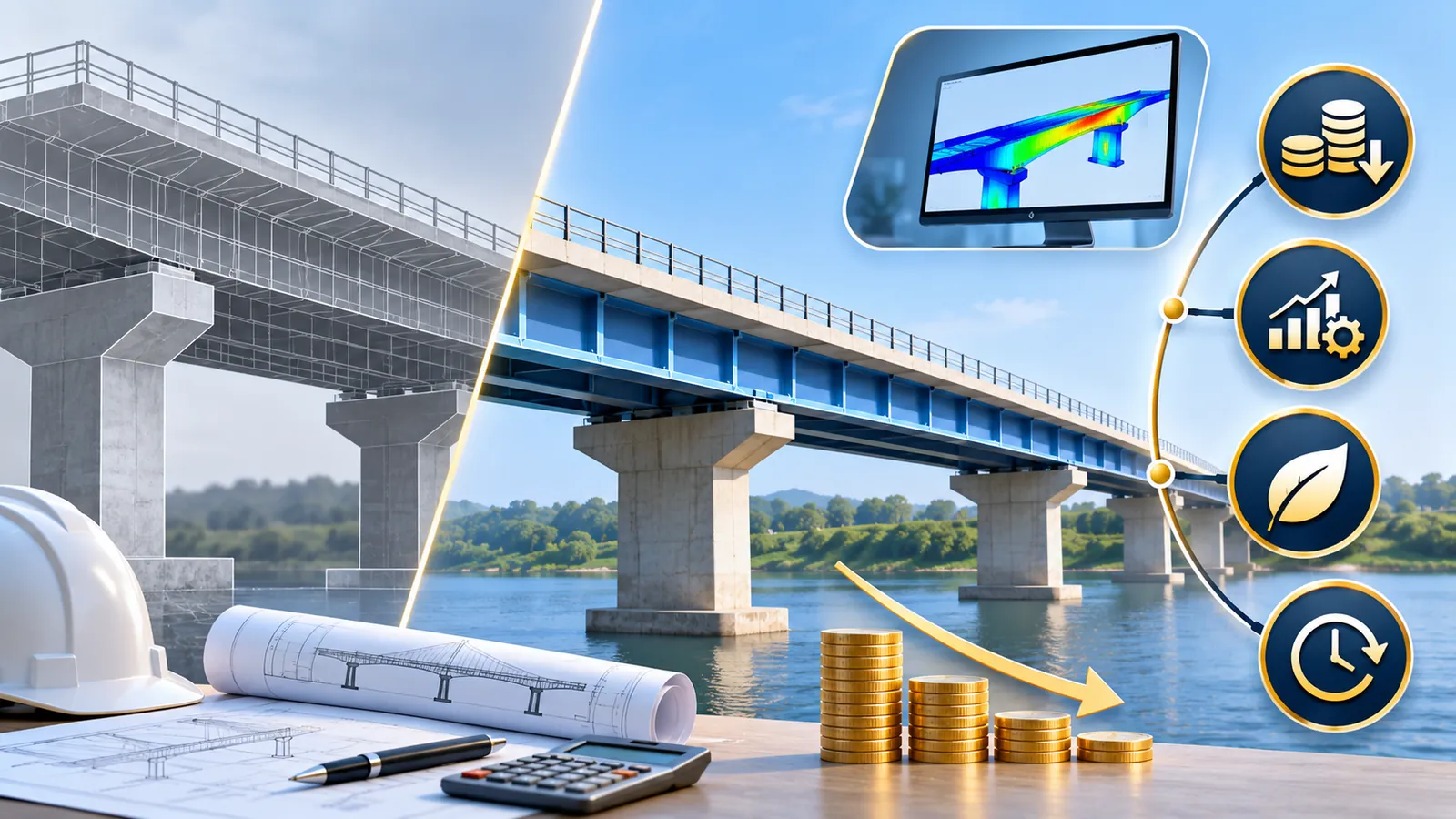
A bridge that costs ₹50 crores and a bridge that costs ₹70 crores can serve the exact same purpose. The difference? Design decisions made in the first 4 weeks of the project. Cost optimization in bridge design isn't about cutting corners — it's about engineering intelligence, span selection, material choice, and avoiding over-design. Done right, you save 20-30% without compromising safety.
WHY BRIDGE COST OPTIMIZATION MATTERS
Bridges are expensive. A single-lane RCC bridge costs ₹50-80 lakhs per meter of span. A 4-lane PSC bridge: ₹2-4 crore per meter. On a 500m bridge, a 10% cost saving is ₹5-20 crores — real money that can fund additional infrastructure.
Yet most bridges are designed with conservative defaults that add 15-30% unnecessary cost. The reasons: design risk aversion, repeating last project's solution, lack of optimization study, or inflexible client briefs.
SPAN OPTIMIZATION: THE BIGGEST LEVER
Span length is the single biggest cost driver in bridge design. For a given total bridge length:
The mistake most designers make is fixing span length without doing optimization. For a 480m bridge:
16 spans of 30m: ₹52 crores total
12 spans of 40m: ₹48 crores total (8% saving)
20 spans of 24m: ₹58 crores total (12% more expensive)
A simple optimization study using 3-4 span configurations can reveal millions in savings.
PSC VS RCC VS STEEL: CHOOSING WISELY
Three main superstructure types compete in Indian bridges. Each has its sweet spot:
PRACTICAL CASE
On the Mage River 84m bridge, we evaluated three configurations: 2×42m PSC box girder (most expensive), 3×28m PSC I-girder (mid-range), and 4×21m RCC T-beam (cheapest but with 5 piers in river). Final choice: 3×28m PSC I-girder — balanced cost, hydraulic clearance, and constructibility.
FOUNDATIONS: WHERE PROJECTS OVERSPEND
Foundations typically account for 25-40% of total bridge cost. Optimization opportunities:
Foundation engineering is where geotechnical investigation pays back 10x. Every borehole, every test, every consolidation reading lets the designer be precise instead of conservative.
OTHER COST OPTIMIZATION OPPORTUNITIES
Cost optimization happens at design stage, not construction.
Once construction starts, optimization opportunities drop by 80%. The first 4 weeks of bridge design — span selection, material choice, foundation type — define the project's total cost. Invest in design rigor.