
Bridge Load Testing: How We Prove a Bridge is Safe

Author: Namotech Team
02 APR 2024
5 MIN READ
Bridge Load Testing: How We Prove a Bridge is Safe
NAMOTECH RESEARCH ARCHIVE

How do you know a bridge can actually carry the loads it was designed for? You test it. Bridge load testing is the ultimate proof of structural performance — applying real loads, measuring real deflections, and comparing with engineering predictions. It's the difference between confidence in design and confidence in reality.

WHEN DOES A BRIDGE NEED LOAD TESTING?

Bridge load testing is required in several scenarios:

KEY PROCEDURAL OBSERVATIONS & STANDARDS
Proof testing of new bridges — Before opening to traffic, especially for long-span structures
Assessment of existing bridges — When upgrading to heavier loads (66T → 100T trailer loads)
After repairs or rehabilitation — Verifying that strengthening works are effective
Damaged bridges — After accidents, floods, or earthquakes
Disputed quality — When concrete grade or construction quality is questioned
Research & calibration — Validating analytical models against real behaviour

NHAI and MoRTH increasingly mandate load tests for bridges with spans above 30m or with complex structural systems. PWDs follow similar protocols for state highway bridges.

IRC SP:51-2015 — THE INDIAN STANDARD

IRC SP:51-2015 is the Indian Roads Congress guideline for bridge load testing. It specifies:

KEY PROCEDURAL OBSERVATIONS & STANDARDS
Load magnitude — Usually 0.7× to 1.0× design live load
Load application — Sequential incremental loading (25%, 50%, 75%, 100%)
Instrumentation — Strain gauges, deflection gauges (LVDT/dial gauges), accelerometers
Hold time — Each load increment held until deflections stabilise (typically 30 min)
Recovery measurement — After load removal, residual deflection must be < 25% of max
Acceptance criteria — Measured deflection ≤ theoretical deflection (with safety factors)

HOW A LOAD TEST IS EXECUTED

A bridge load test isn't a one-day event. It's a structured engineering campaign:

KEY PROCEDURAL OBSERVATIONS & STANDARDS
Phase 1: Pre-test assessment — Visual inspection, NDT, document review, structural re-analysis
Phase 2: Test design — Load magnitude calculation, load truck configuration, instrumentation plan
Phase 3: Instrumentation — Mount LVDTs, strain gauges, set up data loggers
Phase 4: Baseline reading — Initial measurements before load application
Phase 5: Loading — Incremental application via trucks/sand bags/water tanks
Phase 6: Unloading — Sequential removal, residual measurements
Phase 7: Analysis — Compare measured vs theoretical, certify capacity

EXECUTION DETAIL

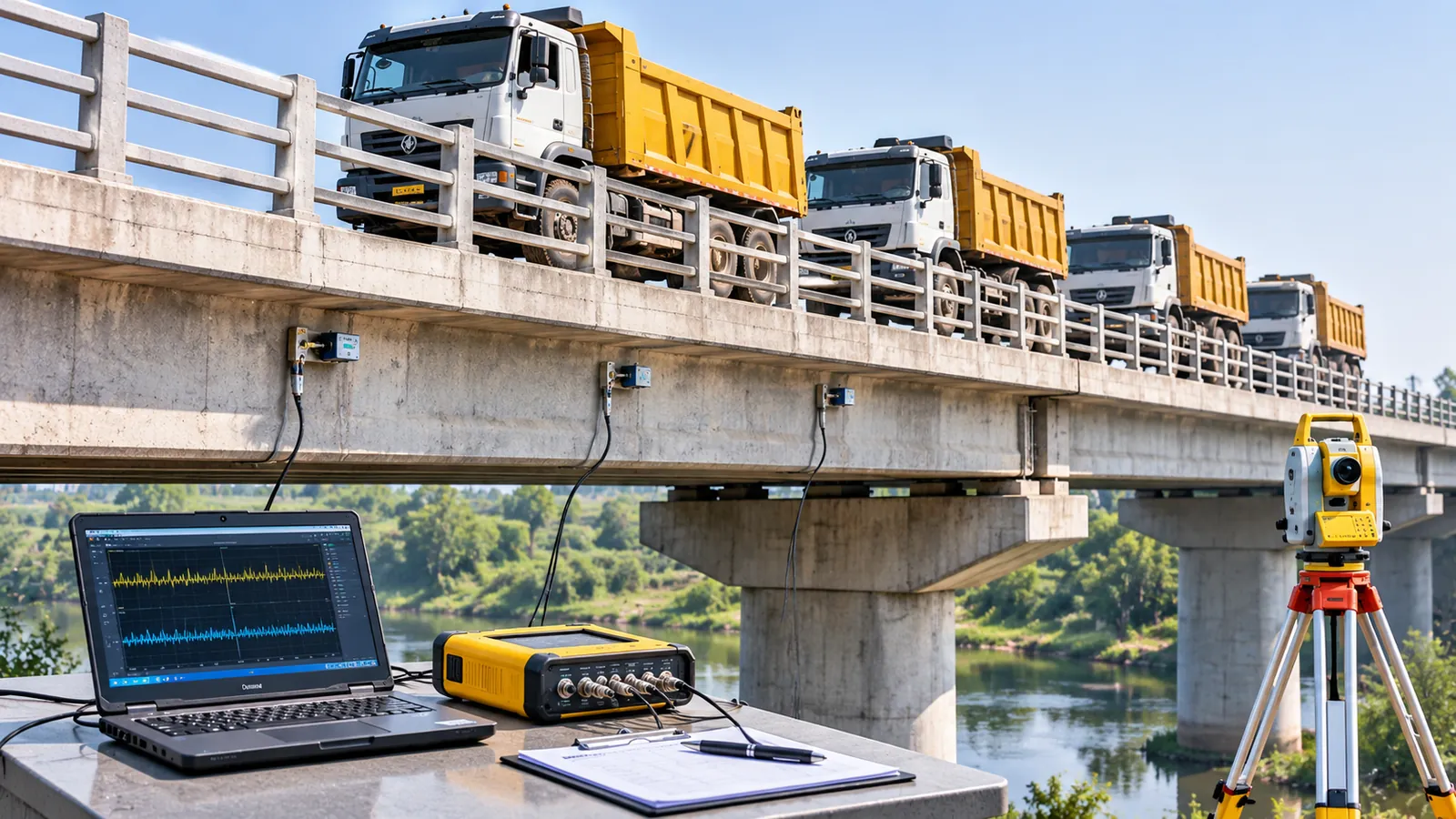
At ROB Bandikui (30m PSC box girder), we used 4 fully-loaded trucks (16T each = 64T total) positioned per IRC load configuration. Mid-span deflection measured was 6.2mm against theoretical 8.4mm — confirming bridge had higher stiffness than designed. Safe verdict, certified for full HL-93 loads.

WHAT LOAD TESTS REVEAL

KEY PROCEDURAL OBSERVATIONS & STANDARDS
Higher actual stiffness than design — Conservatively designed bridges often outperform predictions
Localised distress under load — Cracks appearing only under certain configurations
Bearing problems — Improper bearing seating identified via tilt measurements
Substructure issues — Pier movement under load (settlement, scour effects)
Bridge accelerometry data — Natural frequency, damping (used for health monitoring)

Load testing is the truth serum of bridge engineering.

Designs are predictions. Tests are reality. When safety, liability and capacity certification are on the line, nothing beats actual physical load testing per IRC SP:51-2015.

NEED A BRIDGE LOAD TEST?

Our team executed the 30m PSC box girder load test at ROB Bandikui per IRC SP:51-2015. We have the equipment and expertise.