
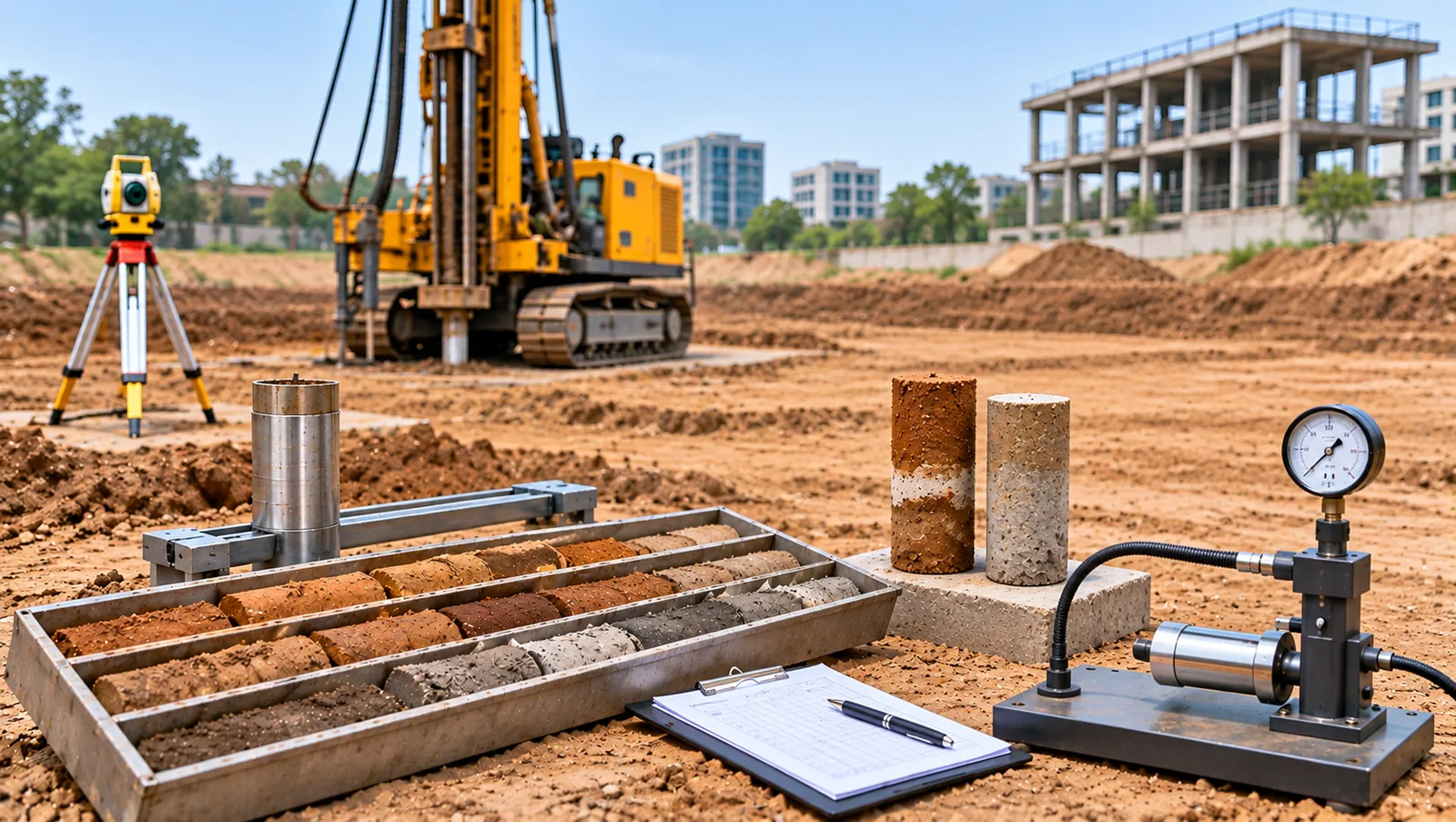
Soil Investigation: The Foundation Below Your Foundation

Author: Namotech Team
12 APR 2024
6 MIN READ
Soil Investigation: The Foundation Below Your Foundation
NAMOTECH RESEARCH ARCHIVE

Every famous structural collapse you've heard of had one thing in common — and it wasn't the visible structure. It was what lay beneath. Soil investigation isn't a tick-box exercise. It's the foundation of every safe foundation. Skip it, skim it, or under-invest in it, and you're building on hope, not engineering.

WHY SOIL INVESTIGATION CAN'T BE SKIPPED

The Leaning Tower of Pisa isn't an architectural curiosity — it's a textbook example of inadequate soil investigation. The tower's foundation was only 3 meters deep on weak clay. Modern engineers wouldn't build a 2-storey house on that soil. Yet across India, projects still proceed without proper geotechnical work — and pay the price years later.

Soil investigation costs 0.1% to 0.5% of project cost. Foundation failure costs 30-50% of building value to remediate (if remediation is even possible). The math is clear.

WHAT A SOIL INVESTIGATION ACTUALLY MEASURES

A proper geotechnical investigation answers these engineering questions:

KEY PROCEDURAL OBSERVATIONS & STANDARDS
What's the safe bearing capacity? — How much load can the soil carry per square meter?
How deep should the foundation go? — Shallow vs deep, isolated vs raft vs pile?
Where's the water table? — Affects construction methodology and uplift design
What's the settlement? — Total settlement and differential settlement predictions
Is the soil expansive? — Black cotton soil swells and shrinks dangerously
What's the seismic site class? — Determines seismic design amplification

ESSENTIAL TESTS IN GEOTECHNICAL INVESTIGATION

KEY PROCEDURAL OBSERVATIONS & STANDARDS
Standard Penetration Test (SPT) — N-values give bearing capacity, density estimation per IS 2131
Plate Load Test — Direct measurement of soil bearing capacity in field (IS 1888)
Atterberg Limits — Plasticity index identifies expansive soils (IS 2720 Part 5)
Direct Shear Test — Cohesion and friction angle parameters
Triaxial Shear Test — Advanced shear strength for important structures
Consolidation Test — Predicts long-term settlement under sustained loads
Permeability Test — Water flow through soil (critical for dewatering planning)
Grain Size Analysis — Sieve + hydrometer for soil classification (IS 1498)

INSIDE LOOK

When we conducted geotechnical investigation across 333 locations for the Etawah-Kanpur road corridor, soil profiles varied wildly within 50m stretches — proving that single bore log assumptions can be catastrophically wrong for linear infrastructure.

READING A BORE LOG

A bore log is the geological story of your site. It shows soil layers, their depths, water table, SPT N-values and physical descriptions. Reading it correctly is half the engineering.

Red flags in a bore log:

KEY PROCEDURAL OBSERVATIONS & STANDARDS
Soft clay layer just below proposed foundation depth — settlement risk
Water table close to surface — dewatering challenges, uplift design needed
Filled-up soil at top — fly ash or construction debris (often missed)
Sudden drop in N-values with depth — weak zone or organic material
Inconsistent profiles across multiple boreholes — variable strata

Number of boreholes matters. For a single building, minimum 3 boreholes. For a township, one borehole per 100m grid. For a bridge, one at each pier location plus abutments. Saving money on borehole count is the most common — and expensive — false economy.

MISTAKES THAT COST PROJECTS DEARLY

KEY PROCEDURAL OBSERVATIONS & STANDARDS
Skipping investigation in 'known' areas — Soil varies dramatically over 50m
Insufficient depth of investigation — Should go 1.5-2x footing width below founding level
No water table monitoring — Investigation done in dry season misses monsoon level
Single borehole for large sites — Average values hide critical weak zones
No correlation with adjacent structures — Existing buildings tell the real story
Trusting cheap vendors — Disturbed samples and fake N-values are common

Geotechnical investigation is engineering economics.

Template:NormalText: ₹50,000-₹5 lakhs spent here saves crores in foundation rework, structural distress, or worse — collapse. Never compromise on geotechnical depth, frequency, or vendor quality.

PLANNING A NEW PROJECT?

Our geotechnical team has conducted 333+ bore logs across India. Start with proper soil investigation.